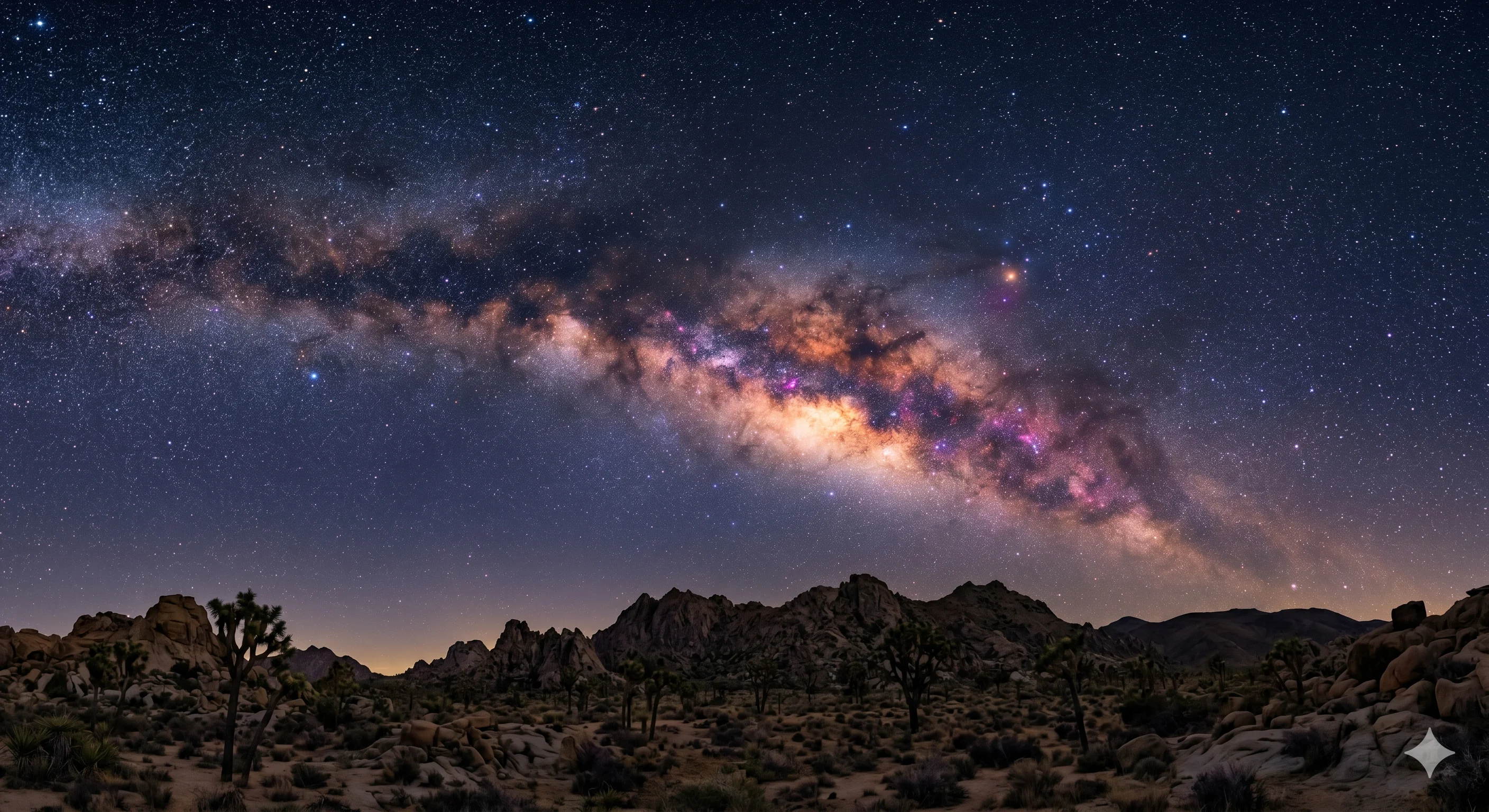
Astrophotography sits at the intersection of science and art. Those images of the Milky Way arching over a lone tree, or a nebula blazing with impossible color — they've inspired generations of photographers to drag telescopes into dark fields at midnight. Real astrophotography demands specialized equipment, remote dark-sky locations, and hours of stacking exposures.
With AI image generation, you can produce images that capture that same cosmic wonder. The challenge is knowing exactly what to ask for. AI models have been trained on thousands of real astrophotography images, but "night sky" alone produces muddy, generic results. This guide gives you the precise vocabulary, prompt structures, and ready-to-use examples to generate astrophotography images that feel genuinely professional.
Why Astrophotography Works Exceptionally Well in AI
Astrophotography has a rich visual grammar that AI models recognize with high fidelity. The style is defined by precise, learnable characteristics: the core-to-arm gradient of the Milky Way, the concentric arcs of star trails around Polaris, the emission nebula colors governed by hydrogen-alpha (red) and oxygen-III (blue-green). These are not random or subjective — they follow physical laws.
This consistency is what makes AI astrophotography prompts so effective. When you describe a nebula with the right color palette and processing terms, the AI draws from millions of examples of actual Hubble images, APOD (Astronomy Picture of the Day) posts, and professional astrophotography that dominate its training data.
The photographers generating truly stunning AI astro images understand three things:
-
Specificity beats generality. "Milky Way over mountains" is a starting point. "Milky Way galactic core rising over the Dolomites, 14mm wide-angle lens, 25-second exposure, f/1.8, ISO 3200, foreground illuminated by ambient light from distant village" gives the AI the full picture.
-
Technical camera terms signal authenticity. Real astrophotography has specific technical fingerprints — the slight coma distortion at wide apertures, noise patterns from high ISO, the tack-sharp stars from a precise 500 rule calculation. Including these terms guides the AI toward photorealistic results.
-
Foreground tells the story. Pure sky images feel abstract. A silhouetted person, an old farmhouse, or a mountain peak gives the cosmic scale human meaning.
Core Vocabulary for AI Astrophotography Prompts
Build your prompts from these term categories. AI models recognize them from millions of real astrophotography images in their training data:
Essential Astrophotography Prompt Terms
Sky & Celestial Features
- •
Milky Way galactic core - •
star trails concentric arcs - •
emission nebula hydrogen-alpha red - •
reflection nebula blue dust - •
globular star cluster dense core - •
aurora borealis green curtains - •
airglow green atmospheric glow - •
zodiacal light faint cone
Camera & Technical Terms
- •
ISO 3200 high sensitivity - •
25-second exposure star points - •
14mm ultra-wide angle lens - •
f/2.8 wide aperture - •
star stacking reduced noise - •
tracker-mounted telescope - •
narrowband Hubble palette SHO - •
LRGB filtered astrophotography
Foreground Elements
- •
silhouetted mountain ridge - •
lone pine tree foreground - •
still lake reflection - •
ancient stone arch - •
astronomer with headlamp red light - •
desert sand dunes foreground - •
coastal cliff edge low horizon - •
light pollution orange horizon glow
Post-Processing Style Terms
- •
boosted saturation star colors - •
stretched histogram deep sky - •
Milky Way color graded teal purple - •
HDR foreground blend - •
luminance mask sky compositing - •
false color HOO palette - •
star reduction processed - •
high dynamic range processed
The Six Core Astrophotography Styles
1. Milky Way Landscape (Wide-Field)
The most searched and shared astrophotography style. The galactic core rises above a dramatic foreground — mountains, deserts, coastlines, or ancient ruins. Success depends on balancing sky brightness against a readable foreground.
Prompt anatomy:
- Galactic core position (rising, overhead, setting)
- Foreground element and its illumination source
- Camera specs (ISO, exposure, focal length)
- Color atmosphere (cool blue, warm amber, teal-purple grade)
2. Star Trails
Long exposures (30 minutes to hours) record star movement as curved light streaks around the celestial pole. The concentric circle pattern around Polaris is iconic in the northern hemisphere.
Prompt anatomy:
- Trail length (short 30-minute arcs vs. full-circle 8-hour trails)
- North or south pole orientation
- Foreground anchor point (lighthouse, observatory, building)
- Sky darkness (blue hour vs. full dark)
3. Deep Sky Objects (Nebulae and Galaxies)
Telescopic images of emission nebulae, planetary nebulae, galaxies, and star clusters. These use narrowband imaging techniques that reveal hydrogen, sulfur, and oxygen emission in distinct colors.
Prompt anatomy:
- Specific object type (Eagle Nebula, Andromeda Galaxy, Orion Nebula)
- Imaging palette (Hubble/SHO: red-green-blue, HOO: hydrogen-oxygen)
- Detail level (wispy filaments, dense core, dark dust lanes)
- Color temperature and saturation
4. Aurora Photography
The Northern (or Southern) Lights demand specific atmospheric conditions and polar latitudes. AI handles aurora extremely well because the phenomenon has well-defined visual rules: green base curtains, pink tops at altitude, occasional rare reds.
Prompt anatomy:
- Aurora intensity (faint arc, active dancing curtains, substorm corona)
- Color composition (green dominant, green-pink, full spectrum)
- Foreground (frozen lake, snow-covered cabin, fjord)
- Sky conditions (partial cloud for drama, or clear dark sky)
5. Comet Photography
Comets have distinct visual elements: a bright nucleus, extended dust tail (white-yellow, curving away from sun), and ion tail (blue, straight, pointing away from sun). AI can render these with photorealistic accuracy.
Prompt anatomy:
- Comet size and brightness (bright naked-eye vs. telescopic)
- Tail separation (show both dust and ion tail)
- Background star field density
- Foreground or constellation context
6. Solar System Targets (Moon, Planets)
Full-disk planetary imaging through telescope, eclipse photography, and moon landscape composites. These have specific surface texture requirements.
Prompt anatomy:
- Phase or disk detail (crescent, gibbous, full disk with feature names)
- Surface detail level (craters, cloud bands, polar caps)
- Background (star field, Earth horizon, space environment)
45 AI Astrophotography Prompts
Milky Way Landscape Prompts
Prompt 1 — Classic Galactic Core
Prompt 2 — Desert Arch
Prompt 3 — Lake Reflection
Prompt 4 — Coastal Cliffs
Prompt 5 — Human Scale
Prompt 6 — Ancient Ruins
Prompt 7 — Winter Milky Way
Star Trail Prompts
Prompt 8 — Full Polaris Circle
Prompt 9 — Short Trails Blue Hour
Prompt 10 — Desert Star Trails
Prompt 11 — Forest Floor Perspective
Deep Sky Nebula Prompts
Prompt 12 — Orion Nebula
Prompt 13 — Eagle Nebula Pillars of Creation
Prompt 14 — Andromeda Galaxy
Prompt 15 — Horsehead Nebula
Prompt 16 — Crab Nebula Supernova Remnant
Prompt 17 — Lagoon Nebula Wide Field
Prompt 18 — Rosette Nebula
Aurora Photography Prompts
Prompt 19 — Active Aurora Substorm
Prompt 20 — Quiet Aurora Arc
Prompt 21 — Aurora over Glacier
Prompt 22 — Aurora with Milky Way
Prompt 23 — Red Aurora
Comet Photography Prompts
Prompt 24 — Bright Naked-Eye Comet
Prompt 25 — Comet over Cityscape
Solar System Prompts
Prompt 26 — Full Moon Detail
Prompt 27 — Saturn Opposition
Prompt 28 — Total Solar Eclipse
Prompt 29 — Jupiter Great Red Spot
Advanced & Creative Prompts
Prompt 30 — Milky Way Over Volcanic Landscape
Prompt 31 — Nightscape Panorama
Prompt 32 — Milky Way Time Blend
Prompt 33 — Perseid Meteor Shower
Prompt 34 — Nightscape with Wildlife
Prompt 35 — Deep Sky Mosaic
Tips & Variations Section Prompts
Prompt 36 — Telephoto Compressed Perspective
Prompt 37 — Fisheye All-Sky
Prompt 38 — Winter Hexagon
Prompt 39 — Southern Cross Southern Hemisphere
Prompt 40 — Gravity's Rainbow Zoomed Nebula
Prompt 41 — Airglow and Milky Way
Prompt 42 — Lunar Eclipse Blood Moon
Prompt 43 — International Space Station Transit
Prompt 44 — Gegenschein Counter Glow
Prompt 45 — Starscape Self-Portrait
Advanced Prompt Techniques for Astrophotography
The Specificity Ladder
Most beginners stay at level 1. Professional-quality results require level 3 or 4:
"night sky with stars"Generic, inconsistent results
"Milky Way over mountains"Better but still generic
"Milky Way galactic core over Rocky Mountains, wide-angle astrophotography, teal-purple color grade"Good results with consistent style
"Milky Way galactic core rising at 45 degrees over jagged Rocky Mountain peaks, Colorado, 16mm f/2 ISO 3200 25-second exposure, tack-sharp stars, natural airglow, foreground illuminated by ambient moonlight, teal-purple Milky Way color grade, APOD-quality astrophotography"Professional, photorealistic output
Color Grading Terms That Work
Real astrophotography is processed with specific color aesthetics that AI recognizes:
- Teal-purple grade: The most popular social media astrophotography look — boosts cyan-teal in the Milky Way dust, purple-violet in the sky gradient
- Natural cold blue: Faithful to sensor data, blue-dominant sky, warm star colors — common in scientific and photojournalistic styles
- Orange-teal contrast: Warm amber foreground (from light pollution or moonlight) against cool teal sky — high contrast and dramatic
- Monochrome luminance: Black-and-white astrophotography showing structure without color — classical and timeless
- Hubble palette SHO: Red sulfur, green hydrogen, blue oxygen — technically named after Hubble Space Telescope imaging conventions
Foreground Illumination Techniques
The foreground is almost always the hardest part to get right. Specify your illumination source explicitly:
| Illumination Source | Prompt Term | Effect |
|---|---|---|
| Full moon | foreground illuminated by full moonlight, cool blue tone | Even, natural-looking |
| Quarter moon | soft moonlight, slight blue cast on foreground | Subtle, atmospheric |
| Headlamp | red-light headlamp illumination, astronomer visible | Moody, human element |
| Light pollution | warm orange-amber light pollution glow on horizon and foreground rock | Urban-wild contrast |
| Campfire | warm orange campfire light illuminating tent and foreground | Intimate, camping aesthetic |
| Intentional light painting | light painted foreground with flashlight, even illumination, no hotspots | Controlled, even coverage |
Frequently Asked Questions
Q: Why do my AI astrophotography images look fake?
The most common cause is over-saturation and impossible star sizes. Real astrophotography has subtle color — the Milky Way dust is a gentle teal-brown, not a neon turquoise highway. Add realistic color saturation, subtle natural star colors, no over-saturation to your prompts. Also, specify that stars should be pinpoints, not giant glowing blobs: tack-sharp star points, no lens flare on stars.
Q: How do I get the Milky Way to look bright and detailed?
Include galactic core specific terms: galactic center region Sagittarius, bright central bulge, dark dust lanes visible, star density gradient from core to arms. The central region near Sagittarius is where the Milky Way is brightest and most structured.
Q: Can I specify a particular constellation?
Yes, and this significantly improves results. Name the constellation and any notable objects: Scorpius constellation with Antares, galactic center visible in Sagittarius above, summer Milky Way, southern horizon view. AI models have strong training data linking constellation patterns to their visual appearance.
Q: How do I make nebula images look more realistic?
Narrowband processing terms transform generic space images into authentic-looking astrophotography: hydrogen-alpha emission, HOO narrowband palette, OIII teal emission, dust absorption lanes. The color comes from specific emission lines, and naming them guides the AI to the right color space.
Q: What's the best way to capture both foreground and sky detail?
Specify it's a composite: two-exposure HDR composite, ground exposure merged with sky exposure, foreground detail visible and stars visible simultaneously, luminance mask blended, professional landscape astrophotography technique. This tells AI to give you an image that mimics the real-world technique of blending multiple exposures.
Q: How do I generate images that look like they came from the Hubble Space Telescope?
Use these specific terms: Hubble Space Telescope aesthetic, WFC3 processed image, SHO narrowband palette (red sulfur, green hydrogen, blue oxygen), space-based imaging no atmospheric distortion, ultra-sharp star points, jewel-like star colors, APOD-quality Hubble image. Hubble has a very specific look that AI models have learned from thousands of press-released images.
Building Your Prompt Library
The most efficient workflow is to build a personal library of prompt components that you mix and match. Here's a starter template framework:
Example assembled from components:
This modular approach lets you generate dozens of variations by swapping single components — different locations, different camera specs, different color grades — while maintaining consistent professional quality throughout.
Astrophotography is one of AI's strongest domains precisely because it has such rich, consistent visual grammar. The universe follows physical laws, and those laws create predictable visual patterns — patterns that AI models learn with high fidelity. Your job as a prompt writer is to speak the technical language of real astrophotographers. Name your objects, specify your camera settings, define your color palette, anchor your sky with a meaningful foreground. The results will surprise you with how closely they match the real thing.
Start with the Milky Way landscape prompts above — they offer the most immediate visual impact and have the widest style range. Then move into deep sky nebulae when you want the color explosion of narrowband imaging. The star trail and aurora prompts will round out your collection with motion and atmospheric drama. With these 45 prompts and the vocabulary guide above, you have everything you need to build a stunning portfolio of AI astrophotography.